
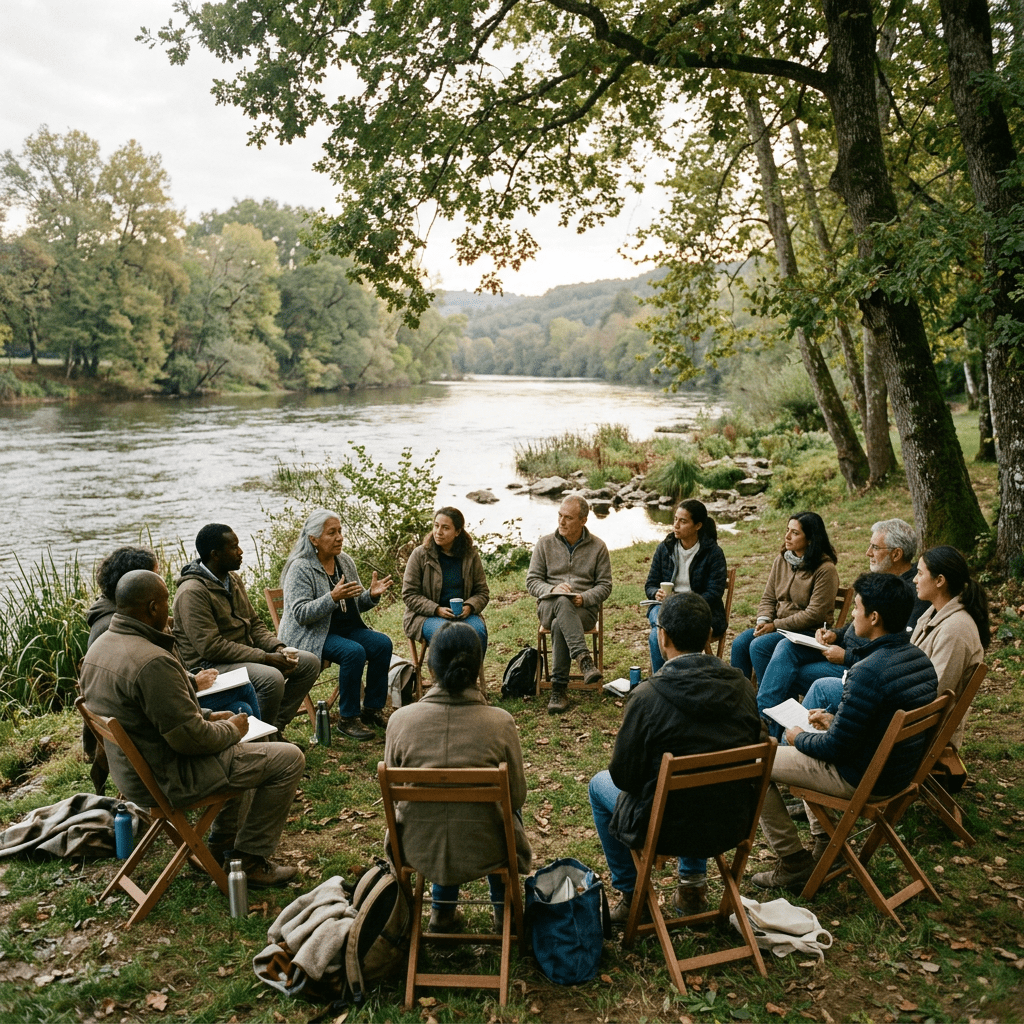
There is a moment in every environmental conflict in India when the argument moves beyond what the law says and becomes, simply, about life. A farming family whose well has run dry because of a factory upstream does not want a legal remedy, at least not first. They want someone to hear them. This is the gap that India’s courts, for all their considerable environmental jurisprudence, have never quite managed to fill. It is the gap that mediation, at its best, is designed to address.
India is a country of extraordinary ecological wealth. It holds roughly eight per cent of the world’s recorded species and seventeen of the planet’s thirty six biodiversity hotspots. It is also a country with enormous development ambitions. The collision between these two realities produces environmental disputes by the thousands: displacement of Adivasi communities for mining, highways cutting through elephant corridors, groundwater contaminated by industrial effluent, rivers dammed and diverted with insufficient regard for those who live from them.
The limitations of courts
India’s legal system has, over decades, built an impressive body of environmental law. The right to a clean environment under Article 21 of the Constitution, the directive principle under Article 48A, the fundamental duty under Article 51A(g) are not empty words. The National Green Tribunal, established in 2010, was a genuine institutional achievement. And yet, within a decade of its creation, the NGT had accumulated a backlog of thousands of cases, faced criticism for insufficient geographical reach, and demonstrated limited enforcement capacity.

The deeper problem is not institutional. It is structural. Litigation is adversarial by design. It produces a winner and a loser. It takes years, sometimes decades. The Cauvery Water Disputes Tribunal took sixteen years to deliver its final award. And again the dispute is flaring up! The Bhopal gas tragedy of 1984, which killed thousands and left hundreds of thousands with lasting health consequences, produced a settlement in 1989 that was widely condemned as grossly inadequate. Sometimes the nature and feasibility of settlements in itself is questionable. Courts can strike down a mining lease but they cannot restore the forest. They can award compensation but they cannot give back what was lost.
What mediation is, and why is it different?
Mediation is a structured process in which a neutral third party, the mediator, helps disputing parties to understand each other’s concerns, identify common ground, and arrive at an agreement they have made themselves. The mediator has no power to impose a decision. The parties remain in control throughout. This is what distinguishes mediation from arbitration, where a decision is handed down, and from adjudication, where a court decides. India’s Mediation Act, 2023, the country’s first standalone mediation legislation, now provides a proper legal framework for this process, including the enforceability of mediated settlement agreements as court decrees.
In environmental disputes specifically, mediation carries several particular advantages. It is faster. Evidence from environmental mediation programmes, particularly in the United States, shows settlement rates between seventy and eighty per cent of participating cases, achieved in months rather than years. It is flexible. A mediator can help parties craft agreements that include ecological restoration, livelihood support, and community monitoring of compliance, things no court can order. It is confidential, which allows parties to speak candidly. And crucially, because the parties make the agreement themselves, they are far more likely to honour it.
There are also deeper reasons why mediation matters in these disputes. Environmental conflicts in India are rarely simple two party affairs. A dam dispute involves the affected community, the project authority, the state government, multiple regulatory bodies, and sometimes other states. A litigation system built for two party disputes handles these polycentric conflicts poorly. Mediation, which can bring all relevant stakeholders to the same table, is far better suited to them.
Lessons from cases India cannot afford to forget

The case of the Jadugoda uranium mines in Jharkhand is instructive. Communities living near the Uranium Corporation of India’s tailings ponds have documented elevated rates of congenital disabilities, cancer, and skeletal deformities for decades. The corporation has consistently contested the evidence, arguing that radiation levels are within permissible limits. This standoff, between community lived experience on one side and official data on the other, is precisely the kind of dispute that adversarial litigation handles worst. A structured mediation process that incorporates independent scientific assessment and genuine community participation would be more likely to produce a resolution that both sides could trust.

The Chipko Movement of the 1970s offers a different kind of lesson. When women of the Uttarakhand hills wrapped their arms around trees to prevent commercial contractors from felling them, they were not merely protesting. They were asserting a claim, that these forests belonged, in a real sense, to the communities that had lived with them for generations. And they made this claim through dialogue, persuasion, and nonviolent resistance rather than litigation. The result was a moratorium on commercial felling in the hills. Chipko achieved through dialogue what years of formal legal argument had not.
India has deep cultural resources for this kind of dialogue. The panchayat system, the tradition of jan sunwais or public hearings, and the gram sabha consultations empowered by the Forest Rights Act are not foreign concepts. They are part of how Indian communities have, for centuries, worked through their disputes. An environmental mediation framework that builds on these traditions, rather than replacing them with an alien procedural model, will be both more legitimate and more durable.
The Obstacles!
Enthusiasm for mediation must be tested against the real obstacles. The most serious is power imbalance. A multinational mining company or a state infrastructure authority brings vastly greater resources, legal, financial, information, to any dispute than the community on the other side. If mediation does not specifically address this imbalance, it will simply reproduce it in a new setting. The solution is not complicated. Independent legal aid and community liaison support must be a precondition for any environmental mediation in which one party is a corporation or government body. A Green Legal Aid Fund, administered by the National Legal Services Authority, could finance this.
A second obstacle is the absence of trained mediators. India currently has no national certification standard for environmental mediators. Mediating an ecological dispute requires knowledge not only of mediation technique, but of environmental law, ecology, community engagement, and indigenous rights. This expertise needs to be built through a National Environmental Mediation Certification Programme, developed in partnership with national law universities and the National Institute of Environmental Studies, targeting five thousand certified mediators within five years.
There is also no institutional infrastructure for environmental mediation in India. The NGT has no mediation wing. State Pollution Control Boards have no mediation protocols. The proposal in the policy literature for Green Mediation Centres, dedicated units at each NGT bench staffed by certified mediators, environmental scientists, legal advisers, and community liaison officers, addresses this directly. The centres would receive referrals from the NGT and High Courts, but also direct applications from affected communities who cannot afford to initiate formal proceedings.
What regulations need to say?
The policy recommendations that flow from this analysis are practical and sequenced. Environment Mediation Rules should be framed under the Environment Protection Act, 1986, making mediation a mandatory pre litigation step for disputes arising from Category A environmental clearances. A National Environmental Mediation Fund, with an initial corpus of INR 500 crore, should be created from a small mandatory contribution from project costs, to subsidise mediation for affected communities. The National Green Tribunal Act, 2010 should be amended to provide for the enforcement and supervision of mediated environmental settlements. And the Forest Rights Act, 2006 should require mandatory mediation before any rejected forest rights claim reaches the courts.
For the courts, the recommendation is to issue practice directions requiring the NGT to refer disputes involving large scale displacement, forest diversion, or pollution affecting more than one district to a Green Mediation Centre for a ninety day mediation period before the matter is listed for final hearing. For the pollution control boards, the requirement to include Environmental Stakeholder Engagement and Mediation Plans in all Category A clearances would ensure that mediation is not an afterthought but part of the life of the project from the start.
A conversation worth having
None of this is radical. It does not require pulling down any existing institution or abandoning any existing legal framework. It requires, rather, the political will to build on what already exists, to systematise what is currently attempted only informally, to fund what is currently underfunded, and to take seriously the idea that the communities most affected by environmental harm have something important to say about how it should be addressed.
A Nilgiri honey gatherer, whose community has lived in the Mudumalai forest for generations, once shared with a researcher: ‘The forest is not a thing we own. It is something we belong to.’ When that belonging is threatened, what is needed is not a judgment. What is needed is a conversation, one conducted in good faith, with proper support for the less powerful party, and with a genuine commitment to hearing what the forest, through the people who know it best, is trying to say.
Mediation, done well, can be that conversation. India has the legal framework, the cultural tradition, and the institutional foundation to make it happen. What is needed now is the commitment to act.
This blogpost is authored by Tejasva Singh from Guru Ghasidas Vishwavidyalaya, Bilaspur, Chhattisgarh and Muhammad Umair Qureshi from GD Goenka University, Gurugram.



Leave a Reply